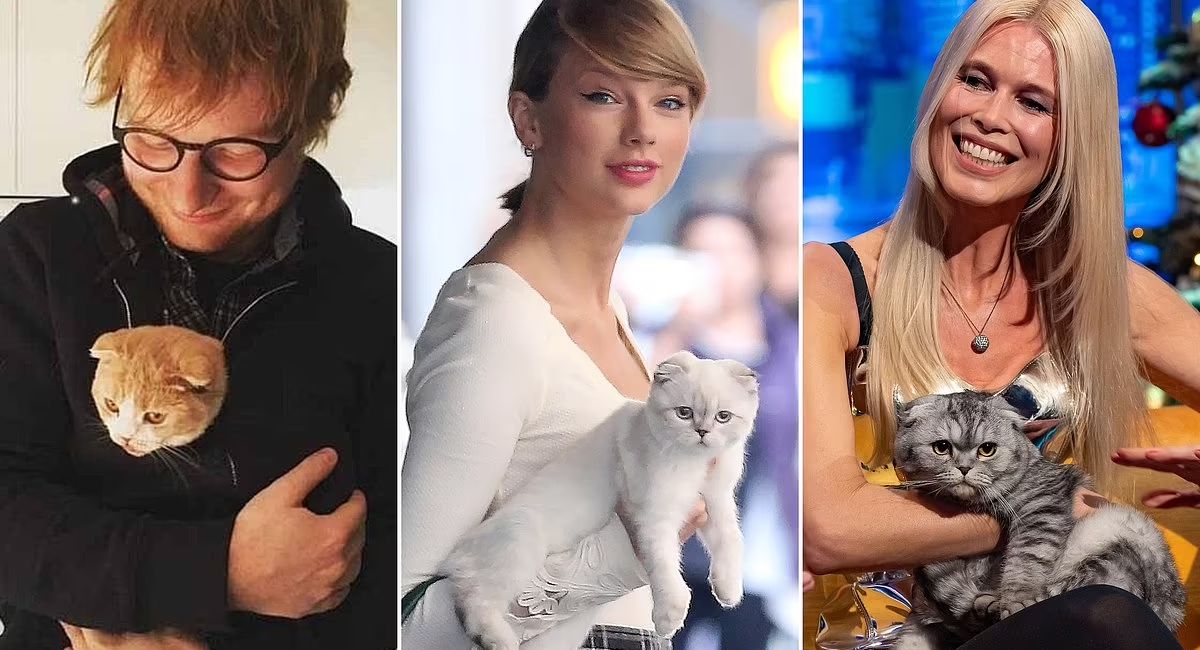
They show up on Instagram in cashmere sweaters, perched on marble countertops, gazing at the camera with round, owl-like eyes. Scottish Fold cats have become a status symbol — part pedigree pet, part content strategy.
But behind the soft lighting and viral posts is a breed story far more complicated than any caption lets on. And in 2026, the story just got significantly more complicated. If you’re shopping for a Scottish Fold in California or simply fascinated by the celebrity-cat economy, this guide covers what the algorithm won’t tell you.
Receipts: Who Actually Owns What (No Rumors, Just Cats)
Let’s start with facts, not fandom gossip.
Taylor Swift is probably the most photographed Scottish Fold owner in the world. Her two cats — Meredith Grey and Olivia Benson — have accumulated millions of views and essentially have their own fan bases. Ed Sheeran is another confirmed owner; his cat Calippo has been featured on his Instagram.
Beyond those two, the verified list includes:
- Kirsten Dunst and Patrick Dempsey — confirmed owners, cited publicly as far back as 2016
- Mia Farrow — also a longtime Fold owner
- Molly-Mae Hague and Claudia Schiffer — more recent additions to the list, both active on Instagram and TikTok with their cats
None of these are rumors. All are publicly documented. What’s notable is the pattern: these are global-reach celebrities with massive social followings — and the cats they chose weren’t random. The Scottish Fold’s distinctive look photographs extremely well.
Why Scottish Folds Are “Rare” and Also… Complicated
The word “rare” gets tossed around a lot in breeder listings. Here’s what it actually means for this breed.
Not every kitten born in a Scottish Fold litter will show the characteristic folded ears — only around 50% develop the desired look. That automatically limits supply, which pushes prices up and creates the perception of exclusivity.
But here’s the part that doesn’t make it into celebrity posts: the same gene mutation responsible for the folded ears may also affect cartilage throughout the entire body, making Scottish Folds more susceptible to arthritis and painful joint conditions known as osteochondrodysplasia (OCD).
A cat with two copies of the Fd gene — bred from two folded-ear parents — almost always shows severe skeletal deformities from kittenhood, including fused tail vertebrae, splayed feet, and restricted mobility. This is why responsible breeders never pair two Folds together.
2026 Global Regulatory Update
The regulatory landscape around Scottish Folds shifted dramatically in early 2026:
| Country/Region | Status as of 2026 |
| Netherlands | Full ban effective January 1, 2026 — buying, selling, or breeding Scottish Folds is illegal |
| UK (Scotland) | Banned by GCCF; Scottish Government consulting new legislation |
| Germany | Breeding prohibited |
| Austria | Breeding prohibited |
| USA (TICA/CFA) | Legal — outcrossing to non-fold parents required |
| California | Legal — no state ban; TICA standards apply |
What the Netherlands ban means in practice: Cats born before January 1, 2026 may be kept for life if microchipped before the ban took effect. Owners of non-chipped cats, or cats born after the cutoff, face fines of up to €1,500. The ban is part of a broader global movement prioritizing animal welfare over breed aesthetics.
This is not a niche development. As one analysis put it, the Netherlands ban is part of a global legislative wave that, in just the first quarter of 2026, has rewritten pet ownership rules across multiple continents. California buyers aren’t directly affected — but the global context matters when assessing breeder ethics and long-term breed viability.
Money, Waitlists, and California Reality
California is one of the most active markets for Scottish Fold kittens in the US. Here’s what the numbers look like in 2026:
| Cost Category | 2026 Estimated Range |
| Pet-quality Scottish Fold kitten (reputable breeder) | $1,500 – $3,000 |
| Show-quality or rare color kitten | $3,500 – $5,000+ |
| Rescue/rehome adoption | $300 – $500 |
| Monthly ongoing care | $80 – $200/month |
| Lifetime vet care (OCD-affected cat) | $5,000 – $15,000+ |
A reputable, ethical breeder in 2026 provides DNA testing, health guarantees, vaccinations, spay/neuter surgery, a microchip, and a signed contract. The top catteries in California currently run 6–18 month waitlists, with waitlist deposits typically starting around $350.
The 2026 floor rule: If a breeder can get you a “purebred registered” Scottish Fold same-day for under $1,000, treat it as a red flag — not a deal. The most ethical programs are small, slow, expensive, and heavily waitlisted.
Scottish Fold vs Scottish Straight (The 30-Second Explainer)
A lot of buyers get confused here. The short version:
Scottish Folds and Scottish Straights can literally come from the same litter. The only meaningful difference is their ears — caused by a dominant gene mutation (Fd). Kittens with one copy develop folded ears; kittens with no copies have upright ears and are called Scottish Straights.
| Feature | Scottish Fold | Scottish Straight |
| Ear shape | Folded forward | Upright |
| Fold gene (Fd) | Yes (Fd/fd) | No (fd/fd) |
| OCD health risk | Yes | None |
| Temperament | Gentle, calm | Identical |
| 2026 price (pet quality) | $1,500 – $3,000 | $800 – $1,800 |
| Global ban risk | Growing | Not targeted |
Scottish Straights carry zero fold-gene-related health risks. Both variants can be screened for HCM (hypertrophic cardiomyopathy). For long-term ease of care, the Scottish Straight gives you everything you love about the breed without the additional monitoring — and without the ethical baggage increasingly being attached to the Fold.
How Celebs Drive the Cat Economy (Yes, Really)
This isn’t a small effect. The surge in Scottish Fold popularity in recent years is directly linked to celebrities and content creators showcasing them on Instagram and TikTok.
The British Veterinary Association has cited the breed’s social media “cuteness” as the primary driver of its demand spike. When Taylor Swift posts a video with Olivia Benson, it generates millions of engagements — and the next day, Scottish Fold breeder websites see spikes in traffic and inquiry volume.
The downstream effects are measurable in 2026:
- Breeder waitlists grow longer after celebrity posts go viral
- Scam listings spike on Craigslist, Facebook Marketplace, and new short-form video platforms
- Prices in high-demand California cities run 20–30% above national averages
- Backyard breeders rush product to market to meet celebrity-driven demand
- Global bans push some buyers toward grey-market imports — a welfare and legal risk
The celebrity economy creates demand. Demand, when it outpaces responsible breeding capacity, creates animal welfare problems. Understanding this cycle is essential before opening your wallet in 2026.
Buyer Reality Check: California Edition
California buyers face a specific set of conditions. The state has strong animal welfare laws, and legitimate breeders are generally well-regulated — but the scam market is equally active.
What a Proper Listing Should Show
- TICA or CFA registration documentation for the kitten and both parents
- OCD screening and HCM cardiac testing results for both parents
- Full vet records and vaccination history
- A signed purchase contract with a health guarantee
- Photos or video of the actual cattery environment
- Breeder available by phone or video call — not just text
Smart Questions to Ask Before You Drop a Deposit
- Are both parents health-tested? Can I see the actual results?
- What is the ear type of both parents? (Responsible breeders never pair Fold × Fold)
- How old are the kittens when they go home? (12 weeks minimum)
- What does your health guarantee cover, and for how long?
- Do you have a return/rehoming policy if I can no longer care for the cat?
- Can I visit the cattery in person or via live video call?
If a breeder hesitates or deflects on any of these, move on immediately.
Care You Don’t See on Instagram
The aesthetic of a Scottish Fold lounging on a velvet couch is Instagram gold. What you don’t see:
- Joint monitoring: Regular vet checkups specifically assessing for OCD are not optional — they’re essential for this breed
- Low-entry litter boxes: As cats age, joint pain may make standard high-sided boxes painful
- Ramps over cat trees: High-jump perches may be uncomfortable for affected cats
- Pain awareness: Scottish Folds are stoic. They hide pain. Behavioral changes — reduced grooming, altered gait, reluctance to move — are warning signs, not personality traits
- Weight management: Excess weight accelerates joint deterioration in OCD-affected cats
The lifetime veterinary cost of caring for an OCD-affected Scottish Fold can easily exceed the original purchase price, covering pain management medications, joint supplements, prescription anti-inflammatories, and mobility-supporting home modifications.
Price Drivers (Decoded, Quickly)
Several factors affect the final price: breeder reputation, lineage, health status, coat color, and market location.
| Factor | 2026 Price Impact |
| Folded ears vs straight | +$400 – $1,000 |
| Rare coat (lilac, smoke, fawn, pointed) | +$300 – $1,200 |
| Show quality conformation | +$1,000 – $2,500 |
| Longhair coat variety | +$300 – $600 |
| Cattery reputation / demand | +$500 – $1,500 |
| California market premium | +20 – 30% |
In 2026, global bans in Europe have tightened supply chains and pushed prices upward even in US markets. Expect reputable California catteries to start at $2,000–$2,500 for a pet-quality folded-ear kitten.
Adoption vs Buying, and the Under-the-Radar Option
Getting a Scottish Fold through a rescue organization is possible, though rare for this breed. Rescue fees typically run $300–$500 regardless of breed.
The under-the-radar option: Retired breeding cats from reputable catteries. These are adult cats, fully health-tested, with known histories — and they often go to verified adopters at little to no cost. Always worth asking about directly when you contact a cattery.
The 2026 smart alternative: The Scottish Straight. Same breed, same temperament, same plush coat, same round face — minus the OCD risk, minus the ethical complications, and usually $500–$1,000 less expensive. As global bans on Folds expand, Scottish Straights are increasingly the pragmatic and welfare-conscious choice.
City Snapshot: LA, SF Bay, San Diego
| City | 2026 Market Notes |
| Los Angeles | Highest breeder density; also highest scam listing density. Verify everything twice. Prices 25–30% above national average. |
| SF Bay Area | Smaller breeder pool; 8–14 month waitlists common. Several well-regarded TICA-registered catteries with strong health-testing records. |
| San Diego | Mid-range availability. Some LA/OC buyers source from San Diego catteries with transport. Slightly lower price premium than LA. |
In all three markets, same-day availability is a scam indicator in 2026. Legitimate catteries book out months in advance.
Bottom Line
Scottish Folds are genuinely beautiful, genuinely affectionate cats — and the celebrity spotlight isn’t fake. Taylor Swift’s cats really do seem well-loved. Ed Sheeran’s cat is objectively adorable. But what the posts don’t show is the vet visits, the joint monitoring, the breeder research, and the responsible sourcing decisions that should precede every purchase.
In 2026, the stakes are higher than ever: the Netherlands has banned the breed outright, global regulatory pressure is building, and California buyers operate in a market where scams have become increasingly sophisticated. Go in with open eyes — verify health testing, understand OCD risk, budget for lifetime care, and seriously consider a Scottish Straight as the smarter long-term choice.
The ears are the only thing you’re giving up. Everything else stays exactly the same.
FAQs
How much does a Scottish Fold cat cost in California in 2026?
Expect $2,000–$4,500 from a reputable, health-testing cattery. Anything under $1,000 from an unverified seller is a scam red flag.
Are Scottish Folds banned in the US in 2026?
No. Scottish Folds remain legal in the US. However, the Netherlands banned them effective January 1, 2026, and global regulatory pressure is increasing. TICA and CFA in the US still require ethical outcrossing.
Do all Scottish Folds develop health problems?
Not all, but all carry genetic risk. Heterozygous Folds (one Fd gene copy) have lower risk; homozygous Folds (two copies, from Fold × Fold breeding) almost always develop severe joint disease.
What is the difference between a Scottish Fold and a Scottish Straight?
Only the ears. Scottish Straights have upright ears, carry no OCD-related genetic risk, and can come from the exact same litter as a Fold.
Are Scottish Folds good for first-time cat owners in 2026?
Their temperament is excellent for beginners — calm, gentle, adaptable. The above-average health monitoring requirements and rising costs make thorough research essential before committing.
Conclusion
The Scottish Fold story in 2026 is one of the most fascinating in the modern pet market: a natural mutation, a celebrity amplification loop, a growing global ban movement, and a buyer landscape full of both legitimate breeders and sophisticated scams. What you see on Instagram is the final frame — not the research, the waitlist, the vet visits, or the ethical sourcing decisions behind it.
If you’re serious about bringing one home, go in with open eyes: verify health testing, understand the OCD risk, budget for lifetime care, stay current on regulations, and consider the Scottish Straight as a smart, welfare-conscious alternative. The best cat for your household might look nearly identical to the one on Taylor Swift’s grid — and come with far fewer complications.
Visit For More Blogs: Infoz Celebritys

I’m Muhammad Zeeshan – a guest posting and content writing expert with 4 years of experience.