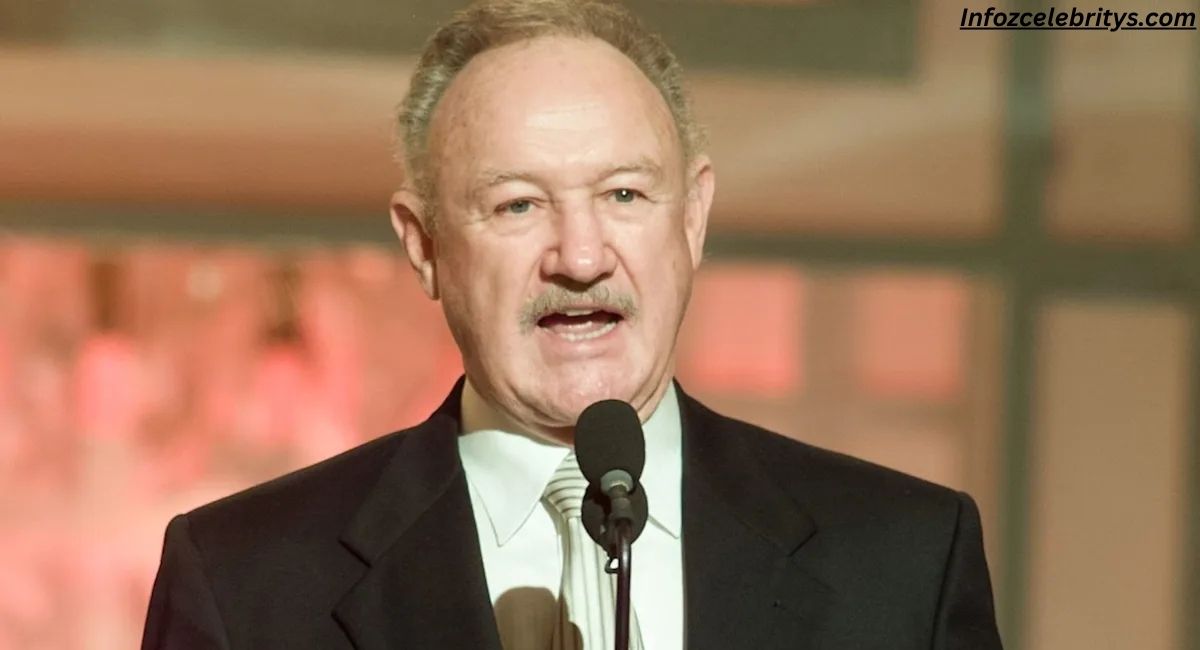
Gene Hackman was not born into privilege. He was not handed a script or a shortcut to fame. What he built — an $80 million fortune, two Academy Awards, and one of Hollywood’s most celebrated careers — came from decades of grinding, reinventing, and refusing to quit. This is the story of the man behind the roles.
Quick Facts
| Detail | Information |
| Full Name | Eugene Allen Hackman |
| Date of Birth | January 30, 1930 |
| Date of Death | c. February 18, 2025 |
| Birthplace | San Bernardino, California, USA |
| Nationality | American |
| Profession | Actor, Novelist |
| Net Worth | $80 Million (estimated) |
| Height | 6 ft 2 in (1.88 m) |
| Spouse(s) | Faye Maltese (1956–1986); Betsy Arakawa (1991–2025) |
| Children | 3 (Christopher, Elizabeth, Leslie) |
| Active Years | 1956–2004 |
| Awards | 2 Academy Awards, 4 Golden Globes, 2 BAFTAs |
Early Life
Eugene Allen Hackman was born on January 30, 1930, in San Bernardino, California, into a modest working-class family. His father, Eugene Ezra Hackman, worked as a printing press operator; his mother, Lydia, held the household together. The family eventually settled in Danville, Illinois, where Gene spent much of his childhood.
Life at home was not easy. When Gene was just 13 years old, his parents divorced and his father left the family — a wound that would shape his emotional depth and drive for years to come. Growing up without financial stability or a stable father figure, young Hackman was restless and eager to break free.
At 16, he made a bold move: he lied about his age and enlisted in the United States Marine Corps. He served as a field radio operator for nearly five years, an experience that instilled in him the kind of discipline and mental toughness that would later define both his characters and his work ethic. He was stationed in China during his service, exposing him to the world beyond small-town Illinois.
After his discharge, Hackman enrolled at the University of Illinois to study journalism and television production, but acting called louder than any classroom. He eventually made his way to the Pasadena Playhouse in California — the same institution where he would cross paths with two future legends: Dustin Hoffman and Robert Duvall.
Breaking Into Acting
The road from Pasadena to Hollywood was anything but smooth. Hackman moved to New York City, where he spent years doing Off-Broadway productions, theater workshops, and small television roles. He studied under acting teacher George Morrison, who helped him channel raw emotion into controlled, believable performances.
He was even told by his acting teachers at the Pasadena Playhouse that he and fellow student Dustin Hoffman were “least likely to succeed.” That rejection became fuel.
His first film appearance was a small bit part as a police officer in the 1961 film Mad Dog Coll. For most of the early 1960s, he struggled — taking any work he could find, waiting tables between roles, and pushing forward on sheer determination.
The breakthrough came in 1964 when he appeared on Broadway in Any Wednesday, which led to increased visibility and better roles. By 1967, everything changed.
Rise to Stardom
The Bonnie and Clyde Moment (1967)
When director Arthur Penn cast Hackman as Buck Barrow in Bonnie and Clyde, it marked his first real taste of Hollywood recognition. His performance earned him an Academy Award nomination for Best Supporting Actor — and Hollywood suddenly knew his name.
The French Connection (1971)
Nothing, however, prepared the world for what came next. Hackman’s portrayal of NYPD detective Jimmy “Popeye” Doyle in The French Connection was ferocious, unpredictable, and completely authentic. He won the Academy Award for Best Actor, along with a BAFTA and Golden Globe, cementing his place in cinema history.
The 1970s and 1980s
Throughout the 1970s, Hackman delivered one compelling performance after another:
- The Poseidon Adventure (1972) – Blockbuster ensemble disaster film
- The Conversation (1974) – Francis Ford Coppola’s paranoia masterpiece
- Superman (1978) – His most commercially lucrative role, earning him $2 million
- Hoosiers (1986) – A fan favorite that showcased his emotional range
Unforgiven and the 1990s Renaissance
Hackman’s second Oscar came with Clint Eastwood’s Unforgiven (1992), where his chilling portrayal of the ruthless Sheriff “Little Bill” Daggett was widely praised as one of the finest supporting performances in film history.
The decade that followed saw blockbuster success after blockbuster success:
- The Firm (1993)
- Crimson Tide (1995)
- The Birdcage (1996)
- Enemy of the State (1998)
- The Royal Tenenbaums (2001)
- Heist (2001)
His final film was the comedy Welcome to Mooseport in 2004. That same year, he stepped away from acting entirely.
Net Worth Overview
Gene Hackman’s estimated net worth at the time of his death was $80 million. This fortune was built over four-plus decades of consistent, high-value work in Hollywood.
Key Earnings Breakdown
| Film / Source | Estimated Earnings |
| The French Connection (1971) | $100,000 |
| Lucky Lady | $1.3 Million |
| The Quick and the Dead | $1.3 Million |
| Superman (1978) | $2 Million |
| Real Estate (Carmel, CA sale) | ~$27 Million |
| Novel royalties & other income | Ongoing |
Sources of Wealth
- Film salaries spanning four decades of leading and supporting roles
- Box office share from films grossing over $1.5 billion in the United States alone
- Real estate investments, including a Santa Fe estate estimated at $8–10 million
- Novel royalties from five co-authored and solo books
- Voice-over work for military documentaries
His smart financial habits and relatively private lifestyle — far from the excess of Hollywood — allowed his wealth to compound quietly over the years.
Personal Life
Gene Hackman married twice in his lifetime. His first marriage was to Faye Maltese on January 1, 1956. Together, they had three children — Christopher Allen, Elizabeth Jean, and Leslie Ann. After 30 years, the couple divorced in 1986.
In December 1991, Hackman married Betsy Arakawa, a classical pianist. The couple built a quiet, deeply private life together in Santa Fe, New Mexico. They were known in the local community for their low-key presence — attending art galleries, cycling, and gardening rather than chasing the spotlight.
Hackman was also known for his passion for competitive racing, having participated in events like the 24 Hours of Daytona Endurance Race and the Long Beach Grand Prix Celebrity Race.
In 1990, he underwent an angioplasty procedure after experiencing chest pains. In 2012, he was struck by a car while cycling in the Florida Keys. Despite these health scares, he continued living actively well into his 90s.
The final chapter of his life was heartbreaking. Betsy passed away on February 11, 2025, from hantavirus pulmonary syndrome — a rare respiratory illness. Gene, suffering from advanced Alzheimer’s disease and severe heart disease, died approximately a week later, around February 18, 2025, at age 95. The two were found together at their Santa Fe home. He was 95.
Physical Appearance
Gene Hackman stood 6 feet 2 inches tall (1.88 m) and carried a commanding physical presence that served him well across a lifetime of roles — from hard-edged detectives to military men and calculating villains.
His rugged, weathered features and piercing eyes gave him an intensity on screen that few actors could replicate. He was never a traditional Hollywood leading man in looks, but his authenticity made him arguably more compelling than any matinee idol of his era.
Life in Retirement
After officially retiring from acting in July 2004 — a decision he said was partly driven by a doctor’s warning about his heart health — Hackman redirected his energy toward writing.
He authored and co-authored five novels:
- Wake of the Perdido Star (1999) — co-written with Daniel Lenihan
- Justice for None (2004) — co-written with Daniel Lenihan
- Escape from Andersonville (2008) — co-written with Daniel Lenihan
- Payback at Morning Peak (2011) — solo novel
- Pursuit (2013) — solo novel
He also lent his voice to military documentaries, including The Unknown Flag Raiser of Iwo Jima (2016) and We, the Marines (2017), honoring his own Marine Corps roots.
In retirement, he painted, fished, and embraced the rhythm of life in the American Southwest. Friends and locals in Santa Fe described him as warm, approachable, and completely unbothered by fame.
Social Media
Gene Hackman had no known personal social media presence. Consistent with his deeply private nature, he avoided platforms like Instagram, Twitter/X, and Facebook throughout his retirement years. His life away from the public eye was intentional and complete. Fan accounts and tribute pages continue to commemorate his legacy online, but Hackman himself never engaged with social media culture.
Fun Facts
- Dustin Hoffman and Robert Duvall were his classmates at the Pasadena Playhouse — all three were labeled “least likely to succeed”
- He served nearly five years in the U.S. Marine Corps, enlisting at just 16
- His film earnings over a career totaled contributions to over $1.5 billion at the domestic box office
- He raced in the 24 Hours of Daytona — an endurance race most non-professionals would never attempt
- His Santa Fe estate sat on 12 acres in the Hyde Park area
- He was awarded the Cecil B. DeMille Award at the 2003 Golden Globes for lifetime achievement
- He was nominated for five Academy Awards and won two — a ratio that reflects both his commercial reach and critical respect
Legacy
Gene Hackman is widely regarded as one of the greatest actors of his generation and a defining figure of the New Hollywood movement. He was the rare performer who could headline a blockbuster action film and anchor a quiet character study with equal conviction.
His influence runs deep:
- He redefined what a “leading man” could look like — flawed, intense, and deeply human
- Younger actors from Brad Pitt to Daniel Day-Lewis have cited him as an inspiration
- His performances in The French Connection, Unforgiven, and The Royal Tenenbaums remain required viewing in film schools around the world
- He proved that great acting does not require vanity — it requires honesty
Beyond the screen, his transition into authorship and his quiet, dignified retirement stand as a model for how a public figure can gracefully step away without diminishing what came before.
Conclusion
Gene Hackman’s $80 million net worth is a number — but it only tells part of the story. The real story is a boy from Danville, Illinois, who left home at 16, got kicked out of acting school, spent years being told no, and then became one of the most decorated actors in Hollywood history. His wealth was built through talent, endurance, and the kind of work ethic only forged by hardship. He never chased celebrity. He chased craft. And in doing so, he built both a fortune and a legacy that will outlast the dollars many times over.
FAQs
How did Gene Hackman make his money?
His wealth came primarily from film salaries, box office earnings, real estate investments, and novel royalties accumulated over a 40-year acting career.
When did Gene Hackman retire from acting?
Hackman officially retired in 2004 after completing Welcome to Mooseport, citing health concerns related to his heart.
Did Gene Hackman win an Oscar?
Yes — he won two Academy Awards: Best Actor for The French Connection (1972) and Best Supporting Actor for Unforgiven (1993).
Was Gene Hackman on social media?
No. Hackman had no personal social media accounts and maintained a fully private life throughout his retirement.
Who were Gene Hackman’s children?
He had three children with his first wife, Faye Maltese: Christopher Allen, Elizabeth Jean, and Leslie Ann Hackman.
I’m Muhammad Zeeshan – a guest posting and content writing expert with 4 years of experience.